Before I start though, a few basics. I was traveling with the Oncocercosis team from HCJB who have been working in this area for over a decade in the treatment, prevention, and control of the disease. One part of this massive effort consists of the fly testing I have been carrying out with colleagues in our laboratory, looking for DNA of the worm-parasite that causes the diseases. However, I wanted to learn a little more about the bigger picture, who exactly were my efforts in the lab serving, what was the area like, how was rural public health carried like this carried out? And thus, through lab contacts, I asked if I could join a field team. The reply, can you leave this next Sunday and how about you spend time with two different field teams? OK! And that is exactly what I did. The experience surpassed my expectations and if you read on I think you’ll see why.
DAY 1:
I arrived at the hospital rendezvous to find, well, no one. Thinking they had left early I searched around a bit before calling Anabel, one of the team leaders. I was assured no, they were just late, how could I forget, this was Ecuador after all!
The first person I met was Don Guido, who told me he was a doctor, I asked if he meant driver, and he said no. I later found out he is a huge joker and not a doctor in the least☺ We picked up Soriya, Anabel, and Margarita (the other team leader) later on and headed all the way to Borbon that first night. We arrived in Borbon quite late and after unpacking in the sweltering humidity/heat we hit the sack. I slept with a fan blowing on me in just underwear and without a single sheet or blanket – it was warm to say the least.

(This was my sleeping set-up in Borbon, in the middle of the medicine room. Mosquito nets are mandatory at night.)

(A map of the project area. The HQ is in Borbon (upper left) and I spent time first in Selva Legre (Rio Santiago) and then in Zapallo Grande (Rio Cayapas). Make sure to click on the pic to enlarge it so you can see where I went.)
DAY 2:
After a big breakfast of fried yucca (a potato-like tuber) we spent the rest of the day preparing materials for the following days work of taking blood samples from children to see if they have the disease. The parasitic worm causing Oncocercosis can live in for 15 years in the human body and thus it is necessary to treat with every person in the area with Ivermectin (which however only kills “baby” worms, thus halting transmission as long as treatment is administered twice a year – until all the adult worms die off). In Communities along the Rio Santiago the disease is thought to be eradicated and thus Ivermectin dispersal has been discontinued and a final check of children is being conducted. Children provide a good confirmation to see if eradication has been achieved as being born more recently they should not have any sign of the parasite. The blood samples were to be collected via a finger prick and absorption of the blood onto filter paper. We would store it for the week in our freezer in Borbon from where it would to go to Quito and ultimately to testing facilities in Guatemala.

(Walking along the dirt streets of Borbon on the way to lunch at a place with the best fruit milkshakes ever!, L-R Margarita, Anabel, and Soriya.)
DAY 3:
We drove out along pot-holed roads for 1.5 hours to reach Selva Legre, the first community where we were to work. The community is almost exclusively Afro-Ecuadorian, descendents of escaped slaves. The night before we had traveled the same route to give an educational talk about the project, why we needed their cooperation, etc.

(Soriya and Anabel taking blood samples, the reward, a lollipop, which the kids (1-16) were all super pumped about.)

(My job was to hear the called out family number, find the entry in the census, and then write on each filter paper the individual's code, family number, and age. It was great practice on local names and with numbers, also being an exercise in concentration as it was face-paced and conducted in a hot room with screaming children.)

(The team at lunch, L-R Hoober (who lives in Borbon), Don Guido, Soriya, me, and Anabel.)
DAY 4:
The next day was more of the same, except most of the kids had come in the first day and only stragglers remained, thus freeing me up to play with little kids! I did some tree climbing and also “kid-swinging” where I would grab them under the arms and propel them up over my head while running forward to simulate a huge jump, they loved it. They were especially fascinated with my camera, crowding around to look after every photo and laughing at their own images.

(Me with some of my camera-fascinated friends:) A slightly older boy from the community was the one who took the pic!)

(Typical houses for Selva Legre, a mix of tin and thatch roofs, made from wood usually which is in contrast to the brick always used in the higher altitudes.)
As the age for testing ran up to 16 I saw a good number of young teenage girls and I couldn’t believe how many were pregnant. Here, if one doesn’t have a kid by 20 something is “wrong.” I met a good number of moms on the trip my age or a year or two older with 3-4 kids and pregnant again! A life of bearing children, and the sad part is many want to stop but don’t know how/don’t have the money/their husbands want more kids.
After lunch, with things still a little slow, we were offered the opportunity to see the “beach.” I thought they meant some part of the river but couldn’t have been more mistaken. At the end of town a huge hole had been gouged in the ground, 10 feet deep and around 100x100ft in area. The beach is where they extract gold and is named thus as the people sifting for the flecks of metal work in flooded pools. An excavator placed dirt on a series of elevated ramps that were sprayed with water to separate out the soil. I was told this operation (not the individual sifters) belongs to a mining company and that they use mercury to extract the gold… mercury which gets flushed into the same pools the people of Selva Legre labor in less than 50 feet away. Apparently a number of people have been suffering debilitating effects from the mercury contamination but nothing much is being done about the situation.

(Working at the "beach" the main source of work for the people of Selva Legre.)
DAY 5:
Was a travel day. I headed upriver to Zapallo Grande, one of the many communities along the Rio Cayapas that can only be reached by water. I was in a motorized canoe loaded down with people and supplies and by the time I arrived, 3.5 hours later, my bum was quite sore from the hard wooden seat with virtually non-existent cushioning. Before embarking on the canoe voyage a local program logistician (one of the many people employed by Onco that do whatever needs to be done) had to tell the canoe operator that I was a medico going to work at Zapallo Grande and thus not to charge me the tourist rate of $10 but rather the normal of $6. He complied, although I couldn’t help but wonder what tourists they were talking about, I didn’t see any my whole trip…

(Blasting up the river in a motorized canoe, a thrill in itself and with great views to boot: forest, birds, women washing clothing on the rivers edge, people in log-carved paddle canoes - lots to look at!)

(Kids!)
The children were all part of an indigenous group known as Chachis that fled the highlands to escape persecution from the Spanish over 500 years ago. Today, they have their own language (chapala) and customs. I learned how to say basic greetings, such as “uru kepe nai nai” – “good morning” and had great fun surprising local Chachis by greeting them in their own language – something they were not expecting in the least from a gringo!

(A typical Chachi house, built elevated to avoid the bugs/animals and for protection from the periodic floods that hit the area. During the course of one night I saw the river rise about 10 feet!)
DAY 6:
The next day I joined Margarita, Luis, and Alfonso on a mission to Loma Linda to distribute Ivermectin. Luis is the dentist for the health clinic but out there everyone does more than their defined role and he helps the Onco teams/acts as a basic doc when he has to. Alfonso is a local Chachi who works with the Onco program and his assistance quickly showed me the importance of local community health workers in having success in a project like this. First, he knows the language, and second he knows everyone and their location. For example, many people were missing from the community due to travel and Alfonso could usually tell us if they were really off far away or just “hiding.” I say that in jest, but to be honest many of the people along the Rio Cayapas (a mix of Chachi and Afro-Ecuadorian communities) didn’t want to take the pill because it didn’t bring them any noticeable or immediate benefits and their lack of education made it difficult to impart the importance of EVERYONE taking the medication in order to wipe out the disease. It was enough to make me wonder why are we helping these people if they don’t even want it? Thinking on this theme later I eventually came to the conclusion that just because they don’t have the education and background to understand what we are doing is a very poor excuse for not doing the right thing; that being trying one’s best to improve their health.

(Weighing the citizens of Loma Linda to deliver the correct dosage, children under 15 kilos and pregnant mothers do not take Ivermectin. my job during this visit was taking blood pressures for all adults over 18 year of age. The Chachi people have notoriously low BPs, 90/60 is quite common with some individuals lower!)
On our way back to base we passed a gigantic raft made of logs and bamboo, the logs being floated all the way to Borbon for eventual use as lumber. Margarita realized we had missed this family and thus we pulled up next to the raft, boarded, weighed everyone, and gave out Ivermectin. It was awesome! The kind of crazy experience I never anticipated doing in my life; to be honest I didn’t even know people did stuff like this before the trip. The Onco team is one dedicated group for sure. They have a motto that if the people don’t come to you, you go to them, wherever that might be. And when they say wherever, they literally mean WHEREVER.

(On the raft!)
DAY 7:

(Breakfast club, L-R: Margarita, Leonardo (the clinic doctor), and Luis.)
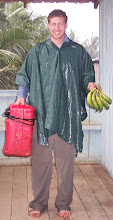
This was how each day started at the station, a big ‘ol breakfast which almost always included “verde” in some form. I think I’ve eaten it in at least 6 different preparations, 4 of them new ones for this trip. Verde is the non-ripened form of a banana different than the one we commonly eat in the US. In fact, the kind Ecuador ships to the states is generally distained here and feed to the pigs and chickens. Cooked verde (you can’t eat it uncooked) most closely resembles potato, but not that closely.
The rest of the morning and into the afternoon I walked around Zapallo Grande itself with Janet, weighing people and giving out Ivermectin. Being just the two of us I did the weighing and pill dispersal while she did all the records. As kids under 15 kilos don’t get Ivermectin (which has general antiparasitic activity) we handed out chewable tablets of Albendazol to combat any intestinal parasites the children were likely to have. Even in the city most everyone gets “de-wormed” about every six months and out here in the jungle the problem is on a whole other level.
Working on the Ivermectin project allowed me unique glimpses into the lives of the people . Babies being rocked in hammocks, women weaving baskets, families’ prized possessions, cooking over open fires, extraction of cacao from its fruit, kids carrying babies, dying people, shy smiles, kids playing marbles, the list could go on.

(An example from my list, kids carrying other kids. Super common here, the parents are out getting food and thus the child-rearing falls to the elder siblings.)
DAY 8:
This day constituted a break from my Onco assistant duties as I shadowed Zapallo Grande’s lone doctor, Leonardo, on an upriver excursion to deliver medical care. Many of the people far upriver who most need care aren’t well enough to travel or can’t afford it and thus it’s imperative for the doctor to go find them.
Our first stop was at an all Chachi village called Barbudo a ways up the side river San Miguel. As soon as we disembarked from out motorized canoe we were met with the news that there was a pregnant women ready to give birth! We hurried up to the hut to find the women in some pain (which had been going on for about 7 hours) and her whole extended family crowded around. They quickly partitioned off a corner to be used as the birthing area with blankets and told everyone to under 18 to leave. The kids merely moved to another corner of the house, this was all too interesting for them to actually leave the premise! Leo checked her cervical dilation and found it to be at a full 10 cm, ready to go! From there he cut the amniotic sack, had the women push, and oh, some hair, the head was out, and, we had a boy! A few seconds of silence before the newborn took his first breathe and then started crying. They pinched off the umbilicus and then cut it before Leo removed the placenta from the mom and cleaned her up, having me apply an oxidizing solution while he mopped up. I thought there was quite a bit of blood but he assured me that no, this was actually as easy and problem free as they come. When we were done a relative came in and washed the blood and other fluids through the cracks in the floor, all set! The experience of watching a new human being brought into the world has been described to me before but it wasn’t until I saw it in person that I was finally able to understand what all the hoopla is about – it really is a miracle.

(The no more than 10 minute old baby boy being wrapped in a blanket and tied up by another family member, the rest of the excited family close by, except the father, who had left the house.)
From there is got weird, or maybe just different, I am still puzzling over it. The baby was wrapped in blankets and then placed next to the mom. When I say next to I mean a few feet away. The mom didn’t take her son into her arms, merely glanced over at him much in the way I might look at the candle sitting on the table in front of me. She quite honestly didn’t seem to care about her newborn. Her actions made me wonder if she was thinking along the lines of, “oh great, another mouth to feed.” What a striking difference from how babies are received in the western world.

(Leo weighing a baby to ensure it was growing sufficiently.)
After our birthing assistance, which lasted all of 30 minutes (gotta be some kind of record!), we headed downriver to another community to offer our services. The majority of our work in this site consisted of vaccinating babies and children, and checking on pregnant moms. There is a new pilot project to look for malaria in pregnant women as this deadly disease can cause even more problems than normal with a baby on board; blood samples were taken for later analysis with the clinics microscope. Leo/a pregnant mom also let me feel the head of a baby through her uterine wall and listen to the fetal heartbeat – supper fast- it was 150 bpm, which is perfectly normal.
A few more pics from events later in the day:

(A Chachi family in their dug-out canoe. This was the most common method of transport for all people living along the river and the ease with which they stood to paddle these thin wooden vessels belied the difficulty I am told is inherent in such travel. I didn't try it personally but would like to, maybe on another visit.)

(Back at base it started to pour, a regular occurance here but this afternoon was more of a torrent than usual. Leo and I used the opportunity to bath in the water falling off the roof!)
A last story from the day; for dinner we had some type of wild critter meat from the forest, quite tasty in fact, and Luis was the lucky one to find 7 shotgun pellets in his portion!
DAY 9:
For my second to last full day I worked with the Onco crew again, this time traveling a few minutes downriver to the town of Telembi. Keep in mind; every location described since I left Borbon is only accessible via the river. Telembi is an almost exclusively Afro-Ecuadorian community and the largest village I visited while upriver.
For this visit we had a similar mission as in Loma Linda, giving out Ivermectin and checking adults BPs, with the additional task of vaccinating youngsters. My job was data recording and taking BPs. People of African descent in general tend to have elevated BPs, especially among the lower classes, and Telembi was no exception. A normal reading is 120/80 and one man here registed 220/120! A finding like that in the states would send someone to the ER but here he just walked out the door after listening to our recommendations. With a silent disease like hypertension, where the only thing an individual feels are headaches at the worst (until the inevitable heart attack or stroke), it is very hard to convince people with almost no education that they have a time bomb ticking away and need to reduce salt intake and start on a medication immediately. Exercise is another key component but most of the people here already do hard manual labor all day long that this point isn’t really applicable to them. I personally took several readings for community members around 190/110 and the community average for adults had to be around 150/100. However, when putting food on the table every day is one’s biggest concern I can see why they have a hard time making BP regulation a priority.

(The room we used in Telembi for Ivermectin distribution, BP checks, and vaccinations. I have never been around so many babies and small children as I was during this trip.)
After the number of people coming in dwindled we took to the streets (muddy paths) to hunt down those who still needed to take Ivermectin. One of the many lessons I’m taking away from this trip is that for rural health initiatives to succeed somebody has to jump in and do the hours of scut work that are anything but glamorous but absolutely critical to making positive change happen.

(Me, crossing a stream in search of more people.)
Back at base the work doesn’t stop; the medical personnel here are extremely dedicated and despite not being paid much and often not receiving said payments very consistently they never stop serving their communities.

(Manuel examining stained slides for signs of malaria in pregnant women from the area. Malaria is fairly common in the area but almost exclusively the less dangerous strain, P. vivax.)
DAY 10:
During the morning and until two in the afternoon I shadowed Leonardo during his clinic time. I have shadowed a number of doctors in the states (including a family practice doc, although not located rurally like this) and have to say there are a fair amount of differences. For starters, there isn’t privacy or patient protection laws like we have, in a number of consults various people, medical assistants, patients, the new police troupe being deployed in town to name a few, all barged right in to talk with Leo. The patients didn’t seem to put off by this either. In addition, after Leo made his diagnosis he didn’t even try to explain what was going on (lack of education of just the style here?) and rather just wrote a prescription. Another big difference, after the consult the patients went directly to the little pharmacy to buy whatever was needed (Leo prescribed the minimum due to the prevalent poverty - $2/month for blood pressure meds can be a tough buy for many families) before returning to the consult room to have Leo explain how they were to take their medications. Often the whole family would come in the room, and after the young boy was checked out for stomach pain (likely parasitic infection) the mom would complain about lower back pain (likely stress damage from carrying heavy items everyday) and get checked out on the spot even though the boy was the only one with the “appointment”!
There is a law in Ecuador that states every child under 5 and all pregnant woman are to receive treatment and medications free of charge, paid for by the government. Well, that all sounds fine on paper, and on the big sign in front of the clinic, but the reality is a different story. As of 8 months back Zapallo Grande (ZG) has not received any medications for these two groups and thus the clinic has been forced to charge in order to have enough money to buy more medicine. The area director has only visited ZG once, for 30 minutes, and didn’t travel any further up river. Given his lack of support for ZG’s clinic it appears rural health doesn’t interest him too much, but the irony is that this is almost exclusively the only kind of care needed in the area! A frustrating situation to say the least.
There was one case from the day stuck in my mind more than all the rest. A family trouped into the room and presented their 7-month-old baby with a persistent cough of the last 3 months. Leo had already tried antibiotics but they didn’t work. Now the baby had lost sufficient weight to be classified in the “red zone” of the growth chart, signifying it was in serious trouble and needed immediate intervention. The baby stopped its crying to utter a phlegmy cough before resuming its pitiful complaints. Leo tried to explain that the family needed to take their child to the city of Esmeraldas or to Quito for more advanced treatment; the parents shifted about nervously at hearing this. At the conclusion the father uttered an expletive under his breath before saying they didn’t have the money for the trip (even though the child’s treatment would be free the parents food and housing expenses wouldn’t be covered). Leo told them to ask family to help out with costs; the man said his extended family didn’t have much money either. Then they left and I honestly don’t know if the baby is still alive as I write this. It’s so hard when shit happens to kids. They are so innocent, and due to where they were born they often just don’t have a chance.
In the late afternoon Luis, Leonardo, Manuel, and I took a hike up to the top of a nearby hill where there is sometimes cell phone reception. It was 30 minutes straight up and with the humidity thrown in I was sweating profusely by the time we summited. The area is nicknamed the “Cabinas Porta” after the popular communications company Porta (cabina means telephone booth). The hike up followed a track dug into the soil where they had previously extracted lumber and at one point I saw a shell-fossil imprint from when the area was once a sea!

(Me at the "Cabinas Porta.")
DAY 11:
Pretty much an entire day of return travel, 2 hours in boat, 0.5 hours by truck, 7.5 hours by bus and a 15-minute cab ride landed back at my doorstep. The one exciting event was when the bus I was on got stopped by police looking for drugs! They didn’t search my stuff too thoroughly and didn’t even ask for ID, just a cursory look and some questions. The event reminded me how close to the border with Colombia I was though.
As the bus lumbered ever upward toward Quito my mind flitted from memory to memory concerning all the amazing experiences I had been privileged to be a part of and the people I had come to befriend. It really was a place I will never forget and I already know I’ll be going back.

2 comments:
You sure the men actually want more kids or just want to continue having sex. Here at least the predominant contraception seems to be abstinence, and I could see that being the same there. Second, the birth may have taken 30 minutes, but what about the 7 hours of labor. Sounds like a ton of great experiences and good practice with a variety of issues in Ecuador. Good to hear.
Dear Michale,
Thank you for putting so much time into your blog. fascinating and a moment in a whole other world. I love that you saw a birth! What does this disease do? How is it contracted? You probably have already written that, but I missed it. You could just refer me. Still proud of you and so glad you are soaking up the experience like a sponge! Love, Babs
Post a Comment