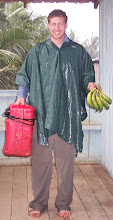
I believe a few years back I was of the mindset that I’d never do anything as silly as keep a blog. Well, times change, as have I, so here goes nothing. I hope you enjoy and feel free to provide feedback.
First, some contact information. Please know that in Latin America the person you call never pays any fees, only the initiating caller. So feel free to call, just use a good plan or you’ll get charged a ton. I will be receiving any mail at the Fulbright Commission compound, as it is more secure.
Cell: (593) 9 858-4703
House: (005) 932 223-8193
Michael Wauters
Comisión Fulbright del Ecuador
Almagro N25-41 y Av. Colon
Quito, Ecuador

(Me writing this blog in my room!)
I planned to post earlier but there have been both technical and intestinal hindrances to said goal. More on those later. I arrived in Quito’s international airport around 11:30pm on September 7th and was super pumped to have no line at customs only to have my enthusiasm dampened when someone’s bag got jammed in the luggage conveyer and hold everything up for 15 minutes or so. Finally getting my luggage I was able to walk out into the pick up area, like a small rock concert with people holding signs for their favorite bands (new arrivals). Dimas, my new padre didn’t have a sign but I recognized him easily from pictures exchanged a few days prior. Dimas is short for Dimitrov and he is from Cuba originally, the Russian sounding name is because of communist links; many Cuban mothers named their children with Russian names for a period of time. Dimas is a web page programmer and has his own company, Kmikaze Media, here in Quito.

(Dimas and his son Julian in the front yard)
I thought I’d sleep like a rock but that wasn’t the case. I forgot to factor in the altitude and in the end slept a max of two hours towards the morning. After groggily rising I met Karla (mi madre) and her and Dimas’ son, Julian (almost 4).

(Karla and Julian in the living room)

(Julian wearing some of my gear)
Karla is originally from Quito and is a graphic designer who works with computers. Both Karla and Dimas have been incredibly helpful, welcoming, and kind. I was planning to stay with them for a few weeks before getting my own place but have had such a good experience that I may stay with them for the duration of my 10 months. For $16/day (about half my monthly stipend) I get my own room, 3 meals a day, laundry, wide band wireless Internet, and the intangibles such as great company and endless Spanish practice. I also like my room.

(A shot of my room)
Soon after breakfast we caught a taxi (which are everywhere and represent a powerful union that shut down the city sometime back by blocking off all major roads!) to the house of Karla’s mother, Laly, for Laly’s birthday. I got to meet the entire family, which amounted to about 50 people! In Ecuador every person greets EVERY other person present at the house. Men shake hands or embrace if close, while women and opposite sex greetings consist of a kiss to the right cheek; right only or problems could ensue! I wanted to be a good guest and so kept accepting the food given to me, probably more than I should have, as after lunch I wasn’t feeling so good.
The next day things were not improving, I had a headache as well as feeling sore all over and my stomach had started to feel a bit queasy in addition. We had gone back over to Laly’s house for a much smaller informal lunch (lunch by the way is the main meal here, served around 2pm and always preceded by soup) and at one point after rising quickly I felt close to fainting. I’ve had problems with this in the past and knew I needed to eat and drink more as soon as possible. I got some food down but my stomach wasn’t happy. I went to lie on a bed and ended up puking a while later. I puked again that night and the next day. The story ended with me in the hospital getting 2 L of lactated ringers to combat my severe dehydration. The emergency room bill was, guess how much… only $46! I ended up losing about 10 pounds in two days.
With the medical stuff behind me I was able to start doing the stuff I had hoped to all along. After getting out the hospital I went to the Fulbright Commission in Quito where I met Karen (programs director- our first contact point for anything) and Susana (Executive director). Karen was very efficient and helpful; providing me with my welcome packet and what I needed to do to set everything up. I was then introduced to Susana who gave me a big hug. She said she felt she already knew me as we had been emailing by this point for over a year and a half. Back when I first started the Fulbright application process I had contacted her for help in finding a researcher working on Chagas disease. After she explained more of the program we chatted for about 45 minutes or so, ranging from my upbringing to how we were both reading books about/by Paul Farmer at the moment! If you don’t know who Paul Farmer is I heavily suggest you google his name right now and find out; a personal hero of mine. Susana’s support for the Fulbright mission of cross cultural understanding through education and research is self evident and I found myself instantly liking this fiery intense woman.
On Tuesday the 11th I got in touch with the head researcher I will be working with, Dr. Angel Guevara, and traveled with him via taxi to the lab on the campus of the Biomedical Center at the Universidad Central del Ecuador, Ecuador’s largest public university. Dr. Guevara is short, clean shaven, and in a word very sharp; his first appearance made any last doubts about the project I was to be working on vanish. I was given a tour of the labs I will be working in and was quite impressed. After the tour I was introduced to the head of the Biomedical Center who told me to not hesitate in asking him if anything came up.
That day Dr. Guevara wanted to check on some mice they had injected intraperitoneally with triatomine feces a few weeks back, strongly suspected of harboring Trypanosoma cruzi (the infectious agent in Chagas disease). After anaesthetizing the mice with ether Dr. Guevara’s partner (Manuel Calvopina, another Doc I will be working closely with who specializes in Leishmania) stuffed them into a “mouse tube” where their tails stuck out a hole in the screw on cap. He then snipped a mm off their tail from behind a face shield and deposited the drop of blood on a slide which I put a cover slip on and brought to Dr. Guevara to examine by light microscopy. We looked at three mice and didn’t see any trypomastigotes (the mobile blood borne stage of T. cruzi). They explanation was that too small an amount of feces had been injected to see the parasites this soon.
I was offered to start coming to the lab full time the next day but had heard warnings that jumping into one’s project too soon can be disastrous. As I was already behind in the game from my sickness I decided to take the rest of this week to sort things out with my living situation/attend to the tasks set before me by the Commission. I bought a small desk and chair for my room that Dimas helped me pick up using his car (almost all cars here are super compact and fuel efficient, perfect for the confines of a city like Quito).
The prospect of not biking (which many of you know is huge passion of mine) for my 10-month stay was too much to contemplate and so I bought a bike for $415. Bike sales here are quite different, one picks out a frame, fork, and component group and then has is it built up. I got the only frame that remotely fit me, a 20” Schwinn High Plains with a Suntour 4” fork and Shimano Acera.

(My new bike!)
In the states this would be beginner stuff but here I was assured it was “muy chevere” or very nice. In my case I actually went into the shop on Thursday and helped them build it to make sure everything was kosher. The shop was small and dirty but I met some super cool guys, Marcelo and Danny who I chatted with about the local scene. It ended up being an amazing time that I kind of lucked into. I’ve talked with a few other Americans who have complained that at one of the big universities (USFQ) there are only foreigners and super rich spoiled Ecuadorian kids and that they have a hard time meeting down to earth people their age. I guess they’re just not going to the right places! The advice about seeking out your passions and the making of friends will follow has been proven to me once again.

(The bike shop show room with Marcelo at center)
Basically no one rides bikes on the roads, I’ve seen maybe 10 people total here do it so far, but there are supposedly a ton of great XC trails in the surrounding mountains. I’ve been using the bike to explore and found as long as I stick to the sidewalks I’m OK. Dodging people, poles, dropping small ledges (no side-walk here is even for long!) and trying not to get run over when crossing roads has proved exceptionally exciting. It’s far more technical than many of the off-road trails I’ve ridden! If I were to explain pedestrian rights in a word it would be “none.” The biggest object rules in the city (watch out for the bus drivers, estan loco!) and people run across streets randomly whenever there is a small gap in traffic. You really have to see it to believe it.
An observation that doesn’t fit into any one day is my improvement in Spanish. Even in just a week in a feel like I’ve bounded ahead of where I started out, vocab, familiarity, comprehension; I can’t wait to assess myself come the end of a few months!
OK, this has become excessively long but I just got my wireless working and can now post it all! Take care, -Michael