
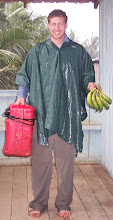
(Theo and I at the Hospital Vozandes Oriente (HVO) in Shell a few months back.)
I got into Shell about 6pm and went in search of Dr. Mark Nelson, my principal contact with HVO for the project. He was on call and after attending to a few patients he gave me a tour of the hospital before we got some dinner at a highly regarded local eatery. After dinner he suggested I visit the interns (final year medical students) and residents who lived on the hospital grounds, so I did! One can’t help but feel a bit awkward entering a house at 9pm at night into a room of people you’ve never met and have no idea you are coming, but they were a welcoming group and after a “who the heck are you” moment we chatted for an hour or so until I had to head back to my hostel. Before leaving they invited me to bunk there the following night! I thought this sounded great but we had to check with an administrator the next day. Instead of paying $10 a night to be alone if I could pay $3 and hang out with some awesome folks there was no way I was going to turn that down!
The following day started at 7:30am for chapel followed by rounds (without actually walking around). The interns/residents got grilled a bit but not too harsh. After the meetings I spent the morning with Mark in the outpatient clinic. Some things I learned: Even though the local diet is super high in fat + salt and low in fiber (the recipe in the US for colon cancer) said cancer is extremely low here. In turn they have very high levels of stomach cancer. Mark informed me the diet results in high constipation levels and this was bore out in the patients we saw, almost every one complained of some type of intestinal ailment. To head off the cancer they schedule lots of endoscopies (which I would spend the next morning watching). In the afternoon I met Miriam, a nurse with around 30 years working in the rural communities of the Ecuadorian Amazon basin, and we packed up the supplies I had brought, tested equipment, and planned out the final details of how the next three days would hopefully go.
During the day everything had been cleared for me to stay in my own room at the student building and that night we cooked up a big communal dinner and hung out, I love doing those but hadn’t had the chance yet in Ecuador, it was great!

(Enjoying a delicious dinner with my new friends in the medical student/resident’s housing quarters.)
Wednesday morning we gathered our gear and headed for the airstrip. The initial flight in consisted of myself, Veronica Redín (our team doctor from HVO), and Miriam. Each person and all the gear was weighed and calculated to make sure we didn’t overload the plane. The little Cessna we were to fly in could take a total of 850 lbs of people/equipment and I think in the end we went 9 lbs over!

(Dr. Veronica Redín in the weigh-in station with our pile of equipment.)

(Our Cessna plane getting loaded up!)
As we were strapping ourselves into the seats I wrote a small note that said, “If I die tell my family I love them. - Michael Wauters 10:41am 6/4/08” and stuck it in my zipper pocket. Luckily it wasn’t needed. As soon as we took off I was in awe of the views and completely forgot about crashing, it was exquisitely beautiful.

(One of many incredible views I would get to see on our numerous short flights.)
The flight to Yuwientsa (YUW - our first destination) normally takes about 30 minutes. Or, one could bus 5 hours over rough roads to Macas, from there another hour plus bus ride to a random spot in the road and it would then be 9 hours hard walking through the jungle to reach YUW. However, we didn’t make it to YUW right off the bat as low lying clouds and rain rushed in as we approached and as all flights/landings (checking for clear runways etc.) are done visually we couldn’t proceed safely. The pilot decided to land us at the nearest community, Katsutka, and try and wait out the weather. As we landed it seemed the whole town was out on the runway… and they pretty much were, as it turns out we visited during a day when the whole village was conducting a communal workday to improve the runway! When the plane stopped we were at once surrounded by inquisitive faces. I felt more out of place than usual, my height, hair, and skin at odds with stockier, darker, raven-haired individuals gazing at me. “You’ve come to help us, this is great! We have many sick people.” a spokesman said.
We weren’t actually supposed to be there at all but we couldn’t fly and there were people that needed our help. So, we did the obvious. We were taken to the community church/meeting building and people started pouring in! I think we attended to over 30 individuals in just a few hours, from stomach parasites to fever to fungal infections. My job was to help prepare the patients for the doctor, taking temperatures, weighing people, and getting a basic history to speed things up. The weather cleared up and we stayed an extra half an hour to see more people. We still left with many unattended to but with the weather able to go bad again at any moment we had to take advantage of our exit window.
To take off on the short runway the pilot gunned the engine while holding on the breaks, allowing us to rocket off and get airborne far more rapidly. We flew for about 10 minutes (3 hour walk) before descending to land in YUW (population ~230). The landing was a rush in itself; it appears you are going to crash into the jungle until the very last moment when you come bursting onto the runway, awesome!
(Video of landing at Yuwientsa!)
From the airplane we were whisked to a meeting building without walls and a steep roof made from local plant materials. Once seated, chunks of sugar cane, slices of papaya, and sugar cane juice were provided. We were all located on one side of a big circle and a number of community members faced us. From the setup I thought we had to give some kind of speech to them but we ended up having more of a relaxed conversation. Miriam knew almost everyone there, my admiration of her in the care and dedication she brings to so many people would only continue to grow throughout the trip. After the refreshments we were taken to our working location.

(The building we both housed and worked in. Nicer than most of what the community had; it was constructed by an outside NGO a number of years back and had running water and a solar powered light! But just one☺)
We then started working, similar to what we had done in Katsutka, providing general medical attention. In the meantime our plane had picked up two individuals, the Daniels, from the town we would travel to next, Makuma, to supplement our efforts. Daniel Chu is a well-respected pastor in the area and a good friend of Miriam’s, he was brought in give a visual reminder of his/the church’s backing and to provide counsel to any who needed it. Daniel number 2, Daniel Kashihin (sp), is a government employed health technician from Makuma who came in to vaccinate all the children of YUW.
Everyone there assumed I was a doctor and used the title as such. I gave up correcting them pretty quick; it was hopeless. My role in YUW was different. I was in the same room as Dr. Redín and played the part of pharmacist more or less. The doc would see a patient, scribble out meds and dosage instructions, then hand me the card from where I would count out pills, mix up powders into drinkable formulas and do whatever else was needed to prepare the medications before then explaining how the people were to take them. This saved her a lot of time and allowed us to attend to a many more people. The people we saw were almost exclusively Shuar, with their own unique language and customs. Many of the women and kids didn’t know Spanish very well and at times we had to have the village health promoter Felipe translate for us. I tried learning a few basic greetings but with limited success; the language is so different that many of the sounds required me to move my mouth and tongue in ways I had never tried. Only one picture this day as I was warned photos can be less than appreciated and I didn’t want to offend anyone. Later on the community grew used to us and I got the go ahead to take a few pics of us at work.

(Me in the “pharmacy.”)
We worked till 10pm and then went right to bed exhausted. I didn’t sleep that well, as it was much colder than I expected and I just had a sheet. YUW is in the rainforest, but still in the foothills of the Andes and at night it can get a bit chilling. The cold combined with my bed of wood and just a thin camping pad (firm to say the least) made it a rather long night.

(I finally got to use my own mosquito net! We’ll see how it worked, if I did get malaria it should show two weeks to a month after initial infection. There is malaria in YUW but at rather low levels.)
The bonus of being rather uncomfortable was that I had no problem getting up early in the morning. Just in time to catch the sun rising over the jungle, withering away the night’s mist. It was a special moment for me; our world can be so beautiful.

(Yuwientsa in the morning.)

(A shot down the runway we arrived on, morning as well.)
One of doctors I work with, Manuel Calvopiña, was supposed to get in around 9am that morning to screen potential leishmaniasis patients and distribute treatment provided by the government for positive cases. The problem was he didn’t arrive till 4:30pm due to a scheduling mishap. The company we were flying with, Mission Aviation Fellowship (MAF), used to be comprised of all foreign missionaries but the new government decreed they had to include half Ecuadorian pilots and mechanics or they would be shut down. A new Ecuadorian pilot was in charge of the schedule that week and he basically did whatever he wanted, screwing us over in the process. Until Manuel arrived we continued to see patients reaching over 105 combining the two days and communities we worked in. This obviously wasn’t an ideal time per patient ratio but with so many you just have to try and do your best. Dr. Veronica Redín headed back to Shell on the flight that Manuel came in on as she was on call the following day.
At this point we switched over to taking blood samples for our study on Chagas disease with Manuel seeing Leishmaniasis patients. It got dark quick (6:30pm like always!) but the people were still there and we kept going. My job was to take the already drawn blood samples, centrifuge them for 8 minutes to separate the various components, and then transfer the serum into a labeled tube for storage in the coolers with icepacks Manuel had brought in. The serum contains all the antibodies we would be looking for while the RBCs, WBCs, platelets etc. just contaminate the delicate ELISA procedure. We had to run the centrifuge off a small generator, as the solar-powered electricity they had wasn’t powerful enough. We got through 37 samples before the people stopped coming at about 8:30pm.

(At work processing the blood samples.)

(Miriam using her headlamp to keep working into night for the blood draws.)
Manuel saw a great number of patients with various types of lesions and thought 4 looked very suggestive of leishmaniasis. He took samples from all of them, 3 per person, and stained them for later microscopic review. You can’t leave samples like that out overnight, as cockroaches will eat the biological material.

(Typical leishmaniasis lesions in the process of scarring over. The bigger risk in the Amazon region is that in 10% of all cutaneous cases (the most common leishmania form) the parasites will migrate to the nose/mouth causing the more dangerous mucocutaneous (MCL) form of the disease which can result in severe disfiguration and even death.)

(Healed lesion and the typical scar left behind. One can see that a lesion on the face would be traumatizing.)
Upon review the next morning one man who looked to be in the beginning stages of MCL was confirmed as positive from his slide. It can be difficult to find the parasites in MCL cases as the body mounts such an intense immune response (which is what actually causes all the tissue destruction) that not many parasites exist at any one time. Manuel was almost 100% sure about his diagnosis from a clinical standpoint but the slide confirmation left no doubt. We gave the man a full regimen of a new oral leishmaniasis treatment called miltefosine, which has about a 70% chance of curing him. We caught his MCL rather early and have hopes he recovers without suffering any further damage. Using the center’s microscope we were able to confirm one more case as positive (cutaneous) and glucantime was left for treatment. The remaining two suspect cases we will be reviewing in the lab in Quito.
We were hoping to see a few more leishmaniasis patients as other community members said they knew of more, but with communication and travel so difficult in the region we were glad that we were able to help at least some.
We worked taking/processing blood samples with Manuel seeing leishmaniasis potentials using my headlamp until 8:30pm. From there we ate a bit and pretty much went straight to bed, exhausted. That night I slept like a rock.
The plane taking us to our next work site, Makuma, was supposed to arrive sometime early that morning and due to the flights putting us behind the day before we worked like maniacs to get as many samples as possible with our limited time. I started off the day doing a number of blood draws, and they all went well! It was nice to take a skill I had only practiced in the lab and employ it effectively in a real situation. However, Miriam wasn’t up to taking over my blood-processing job so I had to switch back after a while so we didn’t get too behind. In just a few hours (working from 7am till 10:30am) we took and processed 58 more samples bringing our YUW total to 95. As this approaches almost half of the community we are confident that if Chagas disease exists in this region we will detect it (there are no existing studies on Chagas in the province of Morona Santiago). When Manuel ran out of leishmaniasis patients he took out the education materials we had brought (a picture of the vector and several real samples of said insect) and spent time educating all those assembled how the disease works, how it is spread, and how to avoid getting it. A number of people commented they had seen the insects in their houses and some even recalled being bitten as well.

(Manuel teaching community members of YUW about the vector for Chagas disease.)
From there we pretty much ran to the plane, whose pilot had been waiting 15 minutes for us to finish up processing our last blood samples. The flight to Makuma was a mere hop of around 10 minutes but would have been 3+ hours walking.

(Health center in Makuma, a village of 400-500.)
Dr. Angel Guevara had joined us in Makuma, coming in on a different flight from Shell. The problem was our already short time allotment in Makuma had been cut down by staying on in YUW to finish (which we had to do as Manuel’s late flight had put us way behind). We worked as fast as possible but only got 44 blood samples and because we were there such a short time (really just an afternoon) only one leishmaniasis patient came in (who was obviously positive and we gave a regimen of the oral treatment miltefosine). The explained reason why many of the leishmania infected people didn’t show up is because they live an hour or two away in the jungle and don’t want to make the walk into town for nothing and unless they hear from a reliable source that yes indeed, the doctors are actually there, they won’t come. This requires us spending more time in a location, like we did in YUW, but in Makuma we just couldn’t, as it was Friday, MAF won’t fly weekends, and the docs had to be teaching classes early Monday morning. We agreed to come back to Makuma to “do it right,” when we have the time. I probably won’t be on that trip but the fact that it gets done is the most important consideration.

(The end team before flying back to Shell. L-R, Miriam, Manuel, Angel, and me. The flight back was gorgeous, weaving in-between huge cloud formations as the sun was getting ready to set. Sadly no photos.)
Conclusions: As I mentioned before the nature of the working environment, namely the difficulty of communication and the spread out living situation make a project such as ours a challenge to carry out. That being said, in YUW we brought much needed general medical attention to a large number of people, vaccinated numerous children, identified and started treatment for several individuals with leishmaniasis, and collected a sufficient number of blood samples to get an idea about Chagas disease in the area. Concerning Makuma we just didn’t have enough time, trying to do two communities like we did with the flight problems just proved to be too much, but plans are already being made to return to Makuma and finish what was started. Now comes the laboratory portion, examining the rest of the leishmania lesion scrapings and testing all the serum samples for Chagas disease. Whether we find more positives or not we already need to procure the medication(s) used in Chagas treatment (benznidazole or nifurtimox) for the positives we previously identified in Arajuno. If we find more people infected from YUW or Makuma this only becomes more important.
In all honesty I had my doubts as to whether the project would ever happen but after months of planning and delays not only did it come to together, it was judged as a success by all involved – the communities, the hospital’s personnel, and ourselves. I feel fortunate indeed to have been a part of this experience. In my eyes it has been the culmination of my time here in Ecuador.

2 comments:
Dear Michael,
I am so proud of you and continue to be amazed at the gusto with which you are approaching each adventure. I can't help but think this is a key element in you being a part of this culminating project, Gusto!!
Love,
Wondering if a slide show with your commentary for donations at the library might be a great next step for you,,, a way to wake up the world!!
W. o. w.
Post a Comment